Do You Need Cash in Korea?
Yes, but you probably do not need a lot of cash. Credit and debit cards are widely accepted in Korea, especially in major cities, but carrying some Korean won is useful for small shops, markets, transportation card top-ups, street food, and backup situations.
Can you travel in Korea without cash?
Mostly, yes. In Seoul and other major cities, cards cover the vast majority of everyday spending: hotels, restaurants, cafes, convenience stores, department stores, and taxis nearly all accept Visa and Mastercard. But going completely cash-free for an entire trip is risky, since a handful of common situations still favor or require cash.
When do you still need cash in Korea?
- Traditional markets and small, family-run restaurants that don't have card terminals
- Street food stalls and food trucks
- Topping up a T-money or transportation card for buses and the subway
- Small purchases at some shops with a minimum card amount
- Backup for moments when a card is declined or a terminal is down
How much cash should you carry?
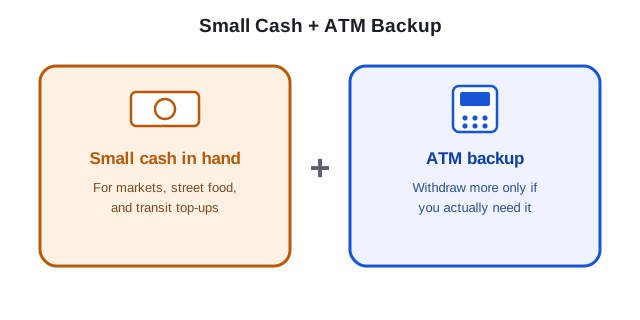
A modest, replenishable amount is usually enough — roughly ₩100,000–₩200,000 to cover markets, snacks, transportation top-ups, street food, and backup situations, not your whole trip's budget. There's no need to carry large sums; ATMs that accept foreign cards are common in cities, so you can withdraw more as needed instead of exchanging a large amount upfront. This is a general planning guide, not financial advice, so adjust it to your own trip length and spending style. Traveling with a partner or a group doesn't multiply this figure — the same range usually covers a couple or family too, since it's for shared spending like a market lunch or a food stall, not a per-person daily allowance. Once you have a number in mind, use the Money Check calculator to convert it into your own currency, and see ATM and card-fee details there.
When does a card work, and when do you need cash instead?
Visa and Mastercard are a safe default almost everywhere in Korea's cities: hotels, chain restaurants and cafes, convenience stores, department stores, and taxis all take cards without a second thought, and that holds in Seoul as much as in Busan, Jeju, or any other major city.
Cash is what you actually need for a narrower, more predictable set of situations: traditional markets, small family-run restaurants without a card terminal, street food stalls and food trucks, and shops enforcing a minimum card purchase. Card acceptance also gets less consistent the further you get from the major cities — smaller towns and rural areas lean more toward cash-only than Seoul or Busan do, so it's worth keeping a bit more cash on hand if your trip goes beyond them.
I watched a visiting friend hit exactly this wall at a street stall in a traditional market — no card terminal in sight, just a price written on a paper sign. She'd been paying by card all week in Seoul and had stopped carrying won entirely, so we ended up walking to the nearest convenience store ATM before she could buy anything. Now it's the first thing I tell anyone visiting: keep a small amount of cash set aside specifically for markets and street food, even if you barely touch it otherwise.
Traveling with others rather than solo doesn't change which of these situations call for cash, but it does change how much to carry between you — see how much cash should you carry above.
Can you use mobile payment apps in Korea?
Not Korea's own ones. Samsung Wallet (Samsung Pay), Kakao Pay, and Naver Pay all require a Korean-issued card, a Korean phone number, and a resident or foreigner registration number to set up — none of which a short-term visitor has, and a Samsung Pay account already set up at home doesn't carry over either, since it's tied to that local registration, not to the phone itself.
Apple Pay and Google Pay aren't the same story, and shouldn't be lumped together the way a lot of travel guides lump them. Apple Pay works with a foreign-issued card at Korean terminals that support international NFC contactless payment, though coverage is still uneven. Google Pay doesn't work at all: Google doesn't list South Korea as a supported country for Google Pay or Google Wallet, so tapping to pay with an Android phone isn't an option here, regardless of which card is loaded on it. See Essential Apps for Korea for the full detail on both, and the rest of Korea's payment-app landscape.
What actually works as a visitor, in short: a physical foreign-issued card, the default that works almost anywhere a card is accepted at all; Apple Pay where it's supported; and a prepaid tourist card like WOWPASS, which you load with foreign currency or cash at a kiosk (Myeongdong and some airport arrival areas) and which also works as a T-money transit card, without needing a Korean bank account. Between a card, a WOWPASS, and a bit of cash, none of Korea's own resident-only apps are something you need.
Do you need to tip in Korea?
No. Tipping isn't expected in Korea — not at restaurants, cafes, taxis, hair salons, or hotels. Prices already reflect the full cost of the service, and leaving extra cash on the table is unusual enough that it can cause more confusion than appreciation; a server may chase you down assuming you left money behind by mistake.
A handful of higher-end hotels and Western-style venues in tourist-heavy areas may add a service charge automatically to the bill, usually shown as a percentage on the receipt — that's the exception, not something you need to calculate yourself. As a simple rule: budget for the listed price, and don't set aside extra cash for tips.
Do you need cash for T-money and transportation?
Often, yes. Most of Seoul's subway, bus, and even some taxi fares run through a T-money card rather than cash directly, and buying or topping up one is one of the more common places travelers still reach for cash. T-money cards are sold at convenience stores (GS25, CU, 7-Eleven) and subway station machines, but many of the older top-up machines only accept cash — some newer station kiosks do take foreign cards, but availability is inconsistent enough that cash is still the more reliable option.
A small stack of ₩1,000 and ₩10,000 notes covers it. For which transit card to actually get, how it works, and cash-free options like WOWPASS, see the full Korea Transit Card Guide.
How do you actually use an ATM in Korea?
Insert your card, and if the screen asks whether to charge you in Korean won or your home currency, always choose won (KRW). Picking your home currency lets the machine apply its own exchange rate instead of your card network's — that's almost always the worse deal. See Money Check for how much a single wrong tap here can actually cost.
Not every Korean ATM takes foreign-issued cards. Before inserting yours, check the machine itself for your card network's own logo — that's the actual signal a machine accepts it, not just an English-language menu option. Visa's own brand guidelines confirm this mark is what signals card acceptance at an ATM, the same way it works everywhere else a card network operates.
Convenience-store ATMs are the easiest to find, but they tend to charge more than a bank's own ATM does — worth knowing before you default to the nearest one purely out of convenience.
Should you exchange money before arriving?
It's usually not necessary to exchange a large amount before your trip. Withdrawing Korean won after arrival, or exchanging a smaller amount locally, is generally convenient and can offer competitive rates — see Money Check for where to withdraw or exchange once you land. Exchanging a small amount before departure can still be useful for immediate needs like transportation from the airport, so you're not hunting for an ATM the moment you land.
So, do you need cash in Korea?
Bottom line: don't land in Korea with zero won, but don't overdo it either. A card handles most of the trip, and a small, replenishable amount of cash covers markets, street food, and the moments a terminal doesn't cooperate. For everything else to check before you fly, see the Pre-Departure Guide.