Korea Weather Check
Check current Seoul and Busan weather, typical weather by travel season, and what to pack for each part of your Korea trip.
For travel planning, Korea's warm season can feel long: March is usually spring, April through September can feel warm to hot (hottest and most humid in July–August), October–November is autumn, and December–February is winter and can feel cold, especially in Seoul. Always check the live forecast below before you finish packing.
Current Weather in Seoul and Busan
Live conditions for both cities, pulled from a public weather service. If it doesn't load, typical seasonal weather is covered further down this page.
Seoul vs Busan Weather
Both cities follow the same travel-season windows below, but Busan's coastal location smooths out some of Seoul's extremes.
Seoul
Colder winters, a long hot and humid summer, and the biggest seasonal swings of the two cities.
Busan
Milder winters than Seoul, with coastal wind and humidity year-round. Useful to know if you're arriving through Gimhae Airport or visiting Busan.
Is Busan colder or hotter than Seoul?
In winter, clearly milder: Busan's average low only drops below freezing in January (-0.1°C), staying at 1.5–2°C in December and February, while Seoul's average low sits several degrees below 0°C all winter (roughly -3°C to -5.5°C).
In summer (June–August), by average daily high, Seoul runs warmer — about 3°C warmer in June, narrowing to 1.5°C in July and under 1°C by August. By average daily mean temperature the gap is smaller but the same shape: about 1.7°C in June, 0.9°C in July, essentially tied by August. September flips it — Busan runs slightly warmer than Seoul by both measures.
Humidity moves separately from temperature: Busan is more humid than Seoul every month from June through September, by as much as 11 points in June. Full month-by-month figures are below.
Winter/summer comparisons above are also from the KMA 1991–2020 normals cited below.
When Do Koreans Usually Recommend Visiting Korea?
Spring and autumn generally bring Korea's mildest, driest weather, but which month actually fits your trip depends on more than that — crowds, budget, heat/cold tolerance, and how Seoul and Busan differ month to month all factor in. See Best Time to Visit Korea for the full month-by-month breakdown and Seoul-vs-Busan guide.
Korea Weather by Travel Season
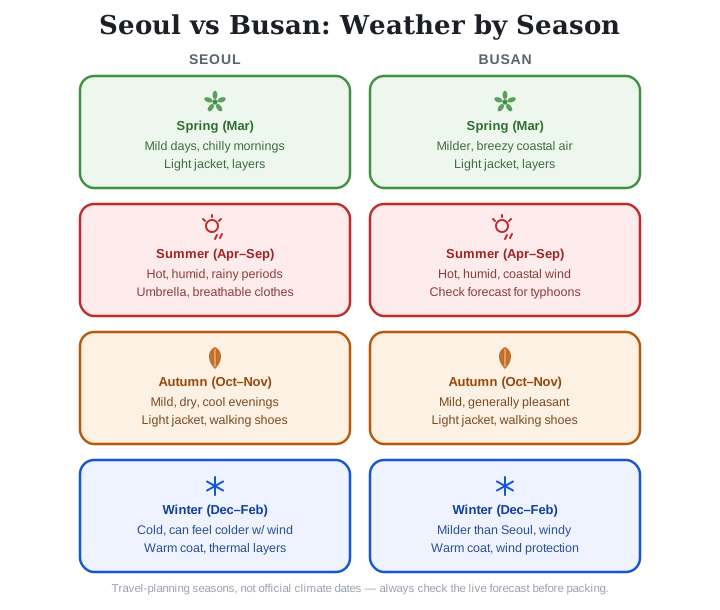
These aren't official climate season dates — they're the travel-planning seasons KoreaPlugCheck uses so packing advice matches how a trip actually feels. Seoul and Busan share the same season windows below; only the weather feel and packing note differ. Actual weather varies year to year, so check the live forecast above before you finish packing.
Spring (March)
Seoul
Cool and changeable, typically around 0–12°C, crisp sunny days are common, mornings and evenings can still feel chilly. Late March brings the very first hints of cherry blossom season in Seoul, though the blossoms themselves usually peak in early-to-mid April, just after this window.
Busan
Typically milder than Seoul, around 5–14°C, with breezy coastal air.
Packing: Light jacket, layers — the gap between a sunny afternoon and a cold morning is usually bigger than the seasonal average suggests, so a packable layer matters more than one "right" jacket.
Summer (Apr–Sep)
Seoul
Long warm-to-hot season, often comfortable in April–May (roughly 10–23°C), then increasingly hot and humid from July into August (typically 24–31°C), with a rainy stretch typically in late June–July.
Busan
Hot and humid with coastal wind, roughly 19–30°C from June through August; check rain and typhoon forecasts, especially late in the season.
Packing: Breathable clothes, umbrella, sun protection, portable fan
Autumn (Oct–Nov)
Seoul
Crisp air, generally clear skies, cooler evenings, roughly 8–19°C across the two months.
Busan
Typically mild, sunny, and pleasant, roughly 13–22°C, with a coastal breeze.
Packing: Light jacket, layers, walking shoes
Winter (Dec–Feb)
Seoul
Cold and dry, roughly -8–3°C, can feel colder with wind.
Busan
Milder than Seoul but windier, roughly 0–10°C — can feel colder than the number suggests.
Packing: Warm coat, thermal layers, gloves, scarf, warm socks
Descriptions are typical for each season as a whole, not a single day's forecast.
Seoul & Busan Monthly Average Temperature Guide
For travelers who want more than a seasonal generalization, here's a rough month-by-month average high/low in Celsius. Treat these as long-term typical ranges, not a forecast — always check the live conditions above closer to your trip.
| Month | Seoul High/Low | Busan High/Low |
|---|---|---|
| January | 1°C / -8°C | 8°C / 0°C |
| February | 4°C / -6°C | 10°C / 2°C |
| March | 10°C / -1°C | 14°C / 5°C |
| April | 17°C / 5°C | 19°C / 10°C |
| May | 22°C / 11°C | 22°C / 15°C |
| June | 27°C / 17°C | 25°C / 19°C |
| July | 29°C / 22°C | 28°C / 23°C |
| August | 30°C / 23°C | 30°C / 24°C |
| September | 26°C / 16°C | 27°C / 20°C |
| October | 19°C / 8°C | 22°C / 13°C |
| November | 11°C / 1°C | 16°C / 6°C |
| December | 3°C / -5°C | 10°C / 1°C |
Figures are long-term averages and will vary year to year — Busan's coastal location keeps its winters milder and its summers slightly less extreme than Seoul's.
Seoul & Busan Monthly Rainfall and Humidity
Busan runs more humid than Seoul for most of the year, and gets noticeably wetter than Seoul from later summer into autumn as typhoon season adds to the rain — worth checking specifically if you're traveling in September or October.
| Month | Seoul Rain | Seoul Humidity | Busan Rain | Busan Humidity |
|---|---|---|---|---|
| January | 17mm | 56% | 35mm | 47% |
| February | 28mm | 55% | 50mm | 49% |
| March | 37mm | 55% | 90mm | 56% |
| April | 73mm | 55% | 141mm | 61% |
| May | 104mm | 60% | 156mm | 68% |
| June | 130mm | 66% | 188mm | 77% |
| July | 414mm | 76% | 327mm | 83% |
| August | 348mm | 74% | 267mm | 79% |
| September | 142mm | 66% | 161mm | 73% |
| October | 52mm | 62% | 80mm | 63% |
| November | 51mm | 60% | 50mm | 56% |
| December | 23mm | 58% | 34mm | 48% |
Long-term monthly averages (1991–2020 normals) from the Korea Meteorological Administration (KMA). A given year can vary, especially around typhoon season (roughly August–October) — check the live forecast above closer to your trip.
What to Wear in Korea by Season
General packing guidance that works regardless of who's packing — adjust to your own comfort and trip length.
Spring (March)
- Light jacket
- Layers
- Comfortable shoes
- Possible fine dust / yellow dust days
Summer (April–September)
- Breathable clothes
- Compact umbrella
- Sun protection
- Portable fan
- Extra socks
Autumn (October–November)
- Light jacket
- Layers
- Comfortable walking shoes
Winter (December–February)
- Warm coat
- Thermal base layer
- Gloves
- Scarf
- Warm socks
- Hand warmers
- Lip balm / moisturizer
Summer Packing for Korea
Korea's summer travel season runs April to September
April and May are often still comfortable, but expect warm-to-hot days from June onward. The most intense heat and humidity usually land in July and August, with a rainy stretch typically arriving in late June to July — locally known as jangma. Late-summer travelers, especially to Busan, Jeju, or other coastal areas, should also check typhoon forecasts before finalizing outdoor plans.
It isn't the steady all-day drizzle a lot of visitors expect — it usually comes as short, heavy downpours that show up with almost no warning, then clear up within an hour. Locals don't bother with a full-size umbrella during this stretch; most of us just grab one of the 3,000–5,000 won umbrellas sold at any convenience store and toss it once jangma's over.
- Sun umbrella / UV umbrella
- Portable fan
- Sunscreen
- Compact rain umbrella
- Breathable clothes
- Quick-dry socks
Winter Packing for Korea
Seoul winters feel colder than the number suggests
Dry, cold air combined with wind can make Seoul winters feel colder than the temperature alone implies. Layering is more effective than one heavy coat — and it matters indoors too. Indoor heating in Korea runs hot — cafes, restaurants, and shops all crank it — which is easy to forget until you're three minutes into a meal, sweating in a wool coat you can't easily get out of at a packed table. A coat you can shrug off and stuff in a bag beats one you have to fully unzip and manage every time you go indoors.
- Thermal innerwear
- Warm socks
- Gloves
- Scarf
- Beanie
- Hand warmers
- Lip balm
- Moisturizer
- Packable down jacket
If you don't already own a pair, disposable hand warmers are cheap and pack flat — worth it for outdoor sightseeing in December–February, skip them if you're not planning much time outside.
As an Amazon Associate I earn from qualifying purchases.
Rainy Season, Humidity, Fine Dust, and Typhoons
A few practical things worth checking before you travel, depending on when you're visiting:
- Fine dust or yellow dust days are more common in spring, especially around March — worth checking an air quality forecast if you're sensitive to it.
- Korea's rainy season (jangma) typically brings a stretch of heavy rain from late June into July.
- July and August usually bring the peak heat and humidity of the travel year.
- Late summer into early autumn, especially trips to Busan, Jeju, or other coastal areas, should include a typhoon forecast check before finalizing outdoor plans.
Check Before You Fly
7 days before
- Check the Seoul and/or Busan forecast for your travel dates
- Check the expected rain and temperature range
3 days before
- Adjust what clothes you're packing based on the updated forecast
- Decide whether you need an umbrella, sun protection, or winter items
1 day before
- Check rain, wind, and any last-minute temperature drop
- Check humidity and air quality if relevant to your trip
Weather is just one piece — see the full Pre-Departure Guide for everything else to check before you fly.