Korea Money Check
Estimate a full Korea trip budget by category, convert it to your own currency, and see how much of it to carry as cash versus put on a card.
Trip Budget Estimator
Rough per-person-per-day planning estimates, not a quote — see exactly what each number assumes further down this page.
Loading reference rate…
Budget estimates are for trip planning only, based on pricing gathered around August 2026. Actual costs vary by exact hotel, restaurant, and itinerary choices.
Convert a Specific Amount
3% is selected by default as a simple planning estimate.
Loading reference rate…
Exchange rates are for travel planning only. Actual rates may vary by bank, card issuer, ATM, exchange counter, and transaction time.
The line item people most often get wrong
Accommodation — not because it's hard to research, but because it's easy to price wrong. A couple planning a Seoul trip often takes a "per person per night" figure and doubles it, when almost every hotel and guesthouse room in Korea is priced per room, not per traveler. Two people sharing a mid-range room pay for one room, not two half-cost bunks. The estimator above prices it the way real bookings actually work — hostel dorm beds per person, since that's how dorms are sold, and everything else per room assuming double occupancy — which is usually the single biggest gap between a rough guess and an actual quote.
How much accommodation swings by region and season
Seoul carries the highest baseline: mid-range hotel rooms run roughly ₩160,000–₩280,000 a night as of mid-2026, with other regions — Busan, Jeju, smaller cities — running around 20–30% cheaper for a comparable room. There's no single official price list for private hotel and guesthouse rates (unlike a government fee), so treat that range as an aggregated estimate, not a quote.
Season is where it gets counterintuitive. During Chuseok or Seollal, the entire country travels at once, and that pushes accommodation up sharply at the actual destinations people are traveling to — hometown regions, resort areas, popular regional cities. But Korean Public Holidays makes a specific point about Seoul itself: a lot of locals leave the city for the holiday, so central Seoul hotels can end up quieter, not pricier, during this exact window. Those are opposite effects depending on where you're actually staying, so the estimator no longer applies one flat multiplier regardless of destination — pick "Seoul + other regions" above and it warns you that regional accommodation and intercity tickets run tighter; pick "Seoul only" and it tells you the real friction is elsewhere (see below).
Why local transport costs so much less than you'd expect
Seoul's transit fare isn't flat — it's distance-based. The base fare (₩1,550 with a T-money card as of 2026) covers trips up to about 10km, with free transfers between subway and bus within that distance, then adds roughly ₩100 for every additional 5km. A short hop between nearby stations lands right at the base fare, but a longer cross-town trip, or a ride out to Incheon/Gimpo airport, costs more — see the Seoul Metropolitan Government's official subway page for the current exact schedule rather than relying on a fixed number here. For a typical day of sightseeing — mostly short hops, with at least one longer ride across districts — the estimator assumes a per-person daily total in the ₩8,000–34,000 range depending on travel style, still cheap by comparison to a lot of visitors' home cities, but noticeably more than "every ride is the minimum fare" would suggest. That daily figure doesn't include the one-time airport transfer on arrival and departure, which runs longer than a typical in-city trip. The exception to all of this is intercity travel: a KTX high-speed train between cities, Seoul to Busan for example, runs about ₩60,000 one-way — see Korail's official site for current fares — which is why the estimator adds it as a separate one-time cost rather than folding it into the daily local-transport rate.
Why cafe and convenience-store prices catch people off guard
It cuts both ways. A coffee at a Seoul cafe chain costs about the same as one in most Western cities — nothing about it is a "cheap Asia" price, which surprises visitors expecting Korea to be uniformly inexpensive. Convenience stores go the other direction: 7-Eleven, GS25, and CU sell fresh kimbap, prepared meals, and instant noodles with hot water on tap for roughly ₩3,000–6,000 — food that's genuinely fine to eat daily, not just backup food. That's why the "budget" travel style above assumes a meaningful share of meals come from convenience stores rather than sit-down restaurants.
How much of your budget should be cash
Not the whole trip's budget, and not a fixed amount either — it scales with what you're actually spending in the categories where cash still matters: markets, street food, T-money top-ups, and small shops with a card minimum. See Do You Need Cash in Korea? for that category list and the reasoning behind it.
The estimator puts the cash share at roughly 15% of your food, local transport, and activities spending (never accommodation, which is almost always card or prepaid), with a ₩100,000 floor so even a short or cheap trip carries a reasonable backup amount. To be direct about where that 15% comes from: it's this calculator's own planning assumption, not a published statistic — no source, official or otherwise, states what share of spending in those categories actually ends up as cash for a typical visitor. Treat it as a reasonable starting guess, not a measured figure, the same way you'd treat your own rough sense of how much cash you personally tend to use.
How much DCC and ATM fees can quietly cost you
Choosing "pay in your home currency" instead of KRW at a card terminal or ATM — dynamic currency conversion, or DCC — typically applies an exchange rate 3–7% worse than your card network's own rate. Applied only to the card-paid share of a trip (cash purchases aren't affected), that usually works out to somewhere around 3–5% of your total budget lost to a single wrong tap at the payment screen, for zero benefit. The fix costs nothing: when the terminal or ATM asks, choose KRW, not your home currency.
Two numbers worth having on hand. Korea's own financial regulator, the Financial Supervisory Service (FSS), has stated that DCC runs roughly 3–8% worse than paying in the local currency directly — the FSS's own guidance, as reported by Financial News. At ATMs it tends to run worse than at a card terminal: a Stiftung Warentest survey cited in the European Consumer Organisation (BEUC)'s 2017 position paper found DCC markups of roughly 2.6–12% on ATM withdrawals against 2–5% on point-of-sale card payments — and at an ATM, that markup sits on top of whatever separate withdrawal fee the machine itself charges, not instead of it.
Korea doesn't have a law requiring a merchant to disclose DCC or honor a refusal, but Visa and Mastercard's own network rules effectively do that job: a merchant or ATM has to offer a genuine choice between DCC and the local currency rather than choosing for you, has to display both amounts, the exchange rate, and the markup, and isn't allowed to apply DCC automatically or make the local-currency option harder to find. If a terminal skips any of that, you're entitled to decline the conversion and report it to your card issuer — worth knowing that's an actual option, not just a "read the screen" tip. Visa's official DCC guidance.
Not every number above carries the same level of confidence. Subway/bus fares, KTX fares, and palace admission are government or public-operator prices with an official page linked above — check those directly for the current exact figure. Accommodation and food have no equivalent first-party price list to link to, since they're set by thousands of independent hotels and restaurants, not one body; those two categories are aggregated planning estimates gathered around August 2026, deliberately left as ranges rather than a single precise-looking number, and are the parts of this estimator most likely to drift over time. The 12% buffer, 15% cash share, and DCC loss percentage are this calculator's own assumptions, flagged as such where each one appears above.
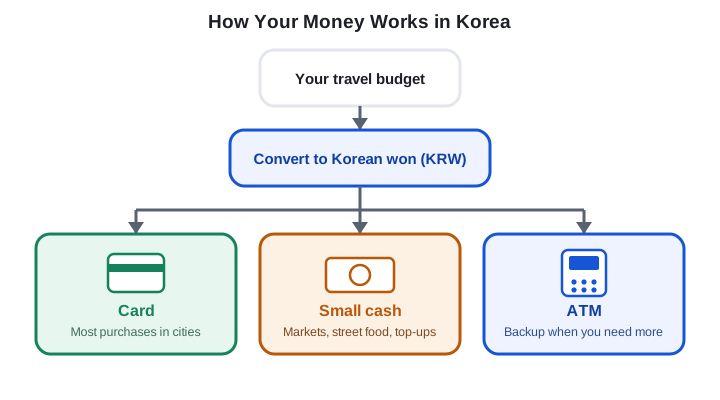
Cards vs cash in Korea
Credit and debit cards, especially Visa and Mastercard, are accepted almost everywhere in Korean cities, including convenience stores, restaurants, cafes, department stores, and taxis. Some very small, independently run shops, traditional markets, and street food stalls may be cash-only or have a minimum card purchase amount. In short: cards cover most of a typical trip in the city, but a small amount of cash is worth keeping as a backup.
When cash is useful in Korea
Korean won still comes in handy at traditional markets, street food stalls, and transportation top-ups. For exactly when and how much cash you need, see Do You Need Cash in Korea?
How much cash should you carry in Korea?
Most first-time visitors don't need to exchange their entire travel budget into cash — cards cover most of a typical trip. Use the "Convert a Specific Amount" tool above once you have a won figure in mind, or the Trip Budget Estimator further up this page if you don't have one yet, and see the full reasoning behind the general cash range in How Much Cash Should You Carry?
ATMs and currency exchange
ATMs that accept foreign cards are available at airports, major bank branches, and many convenience stores (7-Eleven, GS25, CU) in cities, though not every ATM accepts international cards, so it's worth checking for a "Global" or foreign-card-accepted label. Global ATMs from Woori Bank, KEB Hana, and Shinhan are generally reliable for foreign Visa/Plus and Mastercard/Cirrus cards. Currency exchange counters are available at Incheon and Gimpo airports and in exchange zones like Myeongdong.
One thing worth watching for: many ATMs and card terminals will ask if you'd like to pay "in your home currency" instead of Korean won. This is dynamic currency conversion (DCC), and it almost always applies a worse exchange rate than your own card issuer would give you. The prompt is designed to be tapped through quickly, with the home-currency option highlighted by default and the better option (KRW) usually smaller or secondary, so it's worth actually reading the screen instead of hitting the first button. Always choose to be charged in KRW.
Simple recommendation for first-time visitors
Choose a card with low or no foreign transaction fees for the bulk of your spending, and watch for the DCC prompt at ATMs and card terminals. For mobile payments and tipping norms, see Cash & Payments in Korea. For everything else to check before you fly, see the Pre-Departure Guide.